Aside from being out of tune, the most common problem I have to deal with in pianos is lost motion, so I thought I would take a moment here to talk about what lost motion is, why it’s a problem, and why you should give me lots of money to fix it.
I’ve just spent ages trying to type out what lost motion is, why it’s a problem and why you should give me lots of money to fix it and decided that it’s actually really boring. Pianos are complicated inside, and you probably think you have a vague understanding about how they work, but you don’t, and me spending several paragraphs trying to describe it was very dull. So instead I’m just going to tell you what to look out for and then moan about stupid piano design.
So what should you look out for when trying to diagnose lost motion? The first thing is that the keys just feel a bit weird and spongy to play. This is because the key has a certain amount of motion before it properly engages the action and it just feels off. You might even say that this motion is lost. If the touch of your piano feels weirdly off, it could be caused by at least 4301674 different things (pianos are complicated, remember) but the most likely cause is lost motion.
The second thing to look out for is the note sounding twice. The key doesn’t have enough travel in it to fully push the action through its full range of movement, which means that the hammer is left flapping around after it’s hit the string, so it often bounces back and hits the string again. This tends to only happen once the lost motion has gotten quite bad and will be more likely to occur when playing with your little finger (true story, and the explanation why might seem like it could be fun but in actual fact is long and BORING). Again, there are other things which can go wrong which can cause this problem, but lost motion is the most common.
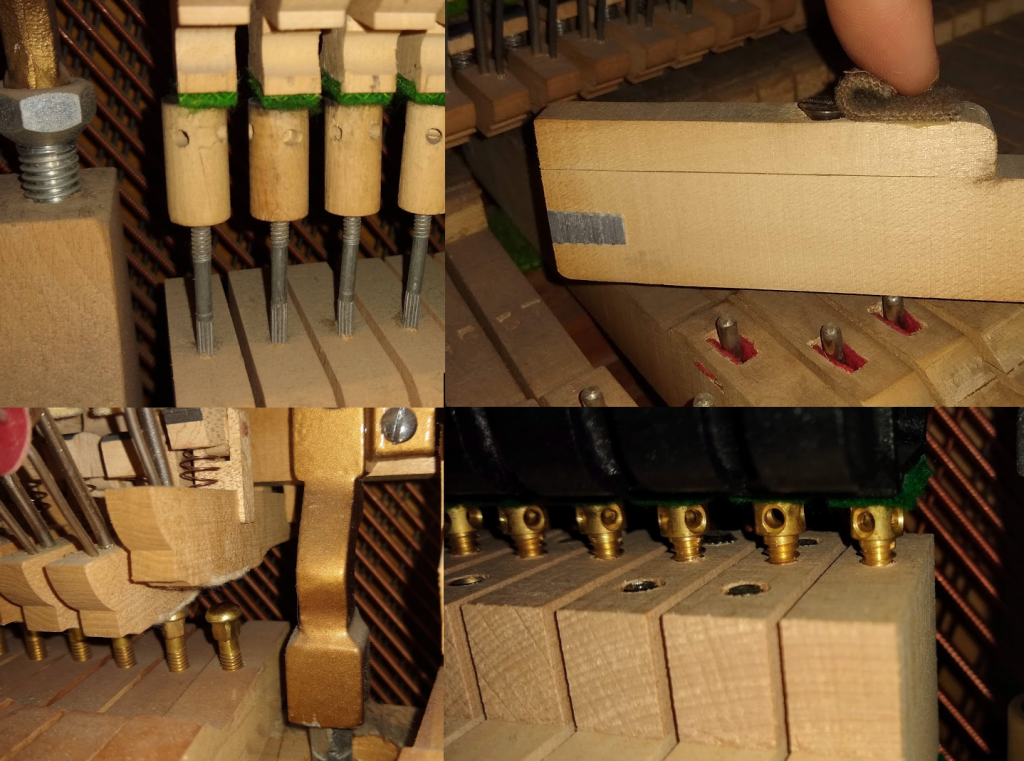
Fortunately, lost motion isn’t all that difficult or time consuming to fix. It normally takes about 20-30 minutes to go through and sort out a full keyboard. (You rarely get it in just one or two keys, it pretty much always effects the whole keyboard.) Which brings us to the place in the blog where I moan about badly designed pianos. To fix lost motion you just have to screw some screws on the back of the keys up to the point where everything engages properly. The picture at the top of this page shows you some examples of these screws and some of them are better than others.
In the bottom right you have an example of a piano with capstans with holes in them. This is the best type of screwy type thing. You just take a long thin thing, poke it in the holes and twist it to wind them up or down. It can be a bit awkward leaning forward at an angle where you can see what you’re doing, but that’s a minor inconvenience.
Bottom left is exactly the same thing, only rather than having holes in them, the capstans are square, so you use a special tool (basically a long spindly spanner) to wind them up. This should be just as easy to adjust as the previous type, only I’ve been stubbornly refusing to buy the tool needed for years now under the pretence that I could just make myself one, only I haven’t gotten round to it yet. This makes it slightly more awkward because I have to use a normal spanner, but it’s still not too bad.
In the top left you have some pilots. And this is where you start getting problems. Brand new pilots are the easiest of all of the screwy things to adjust. You use the same tool as the first type of capstans, and because they’re on long sticks, it makes it much easier to see what you’re doing. The problem comes when the piano starts to get a bit older. As the piano gets older, the wires can get rusted. When the wires rust, the pilots fuse to the wires and refuse to budge, which can be rather frustrating, especially considering that the pilots are just fragile pieces of wood which will very easily break if you put too much force onto them. Sometime, in older pianos this means that lost motion is impossible to get rid of without replacing the pilots. Other times, it is just about possible to get them moving by heating up the wires. When you heat up the wires the metal expands and compresses the wood around them. Then, when the wire cools back down again the metal contracts but the wood stays compressed and so they end up slightly looser. I try to do this when the customer isn’t in the room. People tend to get a bit twitchy when they see someone taking a naked flame to the inside their piano.
The last one Is a normal screw. You tend to only get this in older or cheaper pianos. It’s cheaper to buy a box of screws from the local hardware shop than buying capstans from a specialist piano supplier. These are a right pain. You have to take the key out of the piano to adjust it, so rather than just winding it up to the right point, you have to take the key out, adjust the screw to where you think it might need to go, put it back in, check it, repeat as many times as necessary. Which is awkward enough in and of itself, only you also have to worry about the little bit of cloth attached to the top of the key which has to sit between the screw and the action but will try and fold itself out of the way every time you put the key back in place. It takes almost twice as long to get these right than any other type, and I severely dislike them. At least they don’t seize up quite as often as pilots.
That’s lost motion. I hope this has been informative and I hope it has inspired you to fork over your cash in exchange for me fixing your piano.